Learning Technologies

Five different technologies or technological integrations resonate with me as having the potential for the long-term improvement and enhancement of training and development opportunities. These methods will likely be able to survive shifting political tides, economic conditions, and regulatory frameworks. Raymond Noe defines them as follows:

Blended learning

Since the changes brought about by the COVID-19 pandemic, corporate learners, parents, and college students alike are now familiar with blended learning. We log on to a lecture or webinar-based session where information is presented via a receptive approach (Stolovitch, 2011). Students then use the concepts introduced by the instructor to conduct further research, independent reading or practice, or additional exploration. Following a set period of solo study, the class regroups to confirm understanding, test for comprehension, and debrief.
This resource-saving method reduces costs and time spent on training and allows learners a chance to work when their schedule permits outside of planned real-time interactions. Furthermore, the training can take place anywhere where there is an internet connection. While some learners feel overwhelmed, careful planning by the instructional designer can mitigate the risk of overwork (Noe, 2022). Long before computer-based learning of any kind was in regular use, Charles Wedemeyer proposed 10 suggestions to promote independent learning and integrate technology (Simonson et al., 2019). These, combined with his six characteristics of independent study, are well-suited to the adult learners with whom I work. Technology is a co-facilitator in these arrangements, and the instructor must continue to take an active role.
Wikis

Open-source learning resources are essential in promoting global learning. Students often lack the financial resources to attend formal classes and have turned more and more to social media (Facebook, TikTok, etc.) to find the answers to life’s questions. Sadly, these sources contain as much, if not more, misinformation as they do valuable content. A well-moderated wiki can close the gap. These websites allow social learning to flourish, as contributors from many industries and concentrations can create, edit, and update the articles contained therein (Noe, 2022).
Collaboration and community are key to a successful wiki, as contributors join forces to create informal peer review panels. Close monitoring from SMEs and designers can reduce noise and vandalism and define access control for authors and editors (Mindel & Verma, 2006).
While this arrangement may seem anarchical, it is the free flow of information, digestible at a learner’s pace and discretion, that can allow learning to break from highly regulated and often biased content that can be found in educational institutions at all levels.
Chat Rooms and Discussion Boards
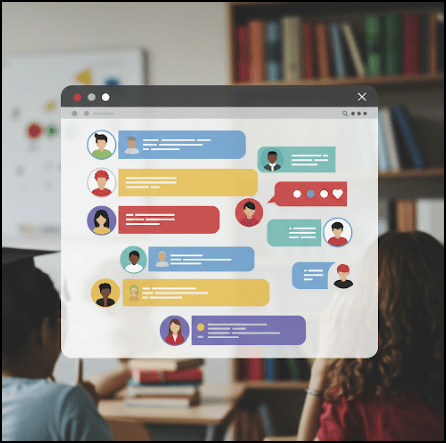
Regardless of the underlying format, discussion posts or chat rooms will continue to be a valuable tool in the instructional designer’s toolkit. Discussions are key to learner engagement and informal student assessments and encourage learners to articulate their understanding of key concepts in ways relatable to them personally (Morrison, 2012a).
For remote learning, chat rooms and discussion boards take the place of a lively classroom environment – or do they? As Morrison illustrates in a three-part series, the following points must be considered:
Course design, expectations, and an involved moderator are key to the effective use of discussion boards (Morrison, 2012a).
Discussion questions can make or break an interaction. A balance of direct and Socratic questions, including possibly controversial topics, can spur insights and deepen understanding (Morrison, 2012b).
If discussions are graded, clear objectives, rubrics, and timely meaningful feedback must be developed and considered before the first chat begins (Morrison, 2012c).
Massive Open Online Courses (MOOC)

MOOCs combine desirable features of blended learning, wiki content, and social media learning. These courses are more economically accessible than traditional postsecondary content. MOOCs contain lectures and other delivery methods such as projects, case studies, etc. MOOCs also include discussion boards and other interactive opportunities (Noe, 2022). Platforms like Coursera, Khan Academy, and others show promise in bringing more structured and advanced learning to learners in remote areas or in environments where certain demographics lack access to formal education (Isaeva et al., 2025).
MOOCs also allow a more consistent and comprehensive application of UDL (Universal Design Learning) to adapt to the needs of learners with various disabilities and learning differences. By presenting the content in a variety of formats, this method maintains a high level of accessibility.
Like discussion boards and wikis, there are concerns regarding accessibility (one must have internet access) and learner motivation. The students have great control over their learning interaction, and surveyed participants state that they favor MOOC over in-person learning (Noe, 2022). Nevertheless, attrition rates are extremely high. There are also concerns with academic integrity, as course completions cannot be authenticated.
Augmented Reality

This method of training allows learners to interact with simulations of actual working scenarios in conjunction with experts, instructions, etc. (Noe, 2022). This method of instruction is valuable not only for pre-work training but also for on-the-job instruction. Workers using augmented reality (AR) can consult manuals or user guides in real time, working through step-by-step processes without stopping workflow or leaving the area.
AR goes beyond virtual reality (VR) in that the learner is still in the actual work or learning environment and is not cut off from the learning experience, the instructor, or other learners. This method also provides learners with a low-risk environment to practice skills that, if performed incorrectly, could cause harm (for example, medical skills).
AR is currently prohibitively expensive. Headsets or glasses to allow the technology can cost thousands of dollars, and each learner must have their own equipment. Learners with visual processing disorders cannot use the technology, and even those with no disabilities can experience symptoms of vertigo. While AR currently has challenges, the success of games like “Pokemon Go!” illustrates the lasting appeal of this technology. Future developments will hopefully make this more accessible.
References:
Isaeva, R., Karasartova, N., Dznunusnalieva, K., Mirzoeva, K., & Mokliuk, M. (2025). ENHANCING LEARNING EFFECTIVENESS THROUGH ADAPTIVE LEARNING PLATFORMS AND EMERGING COMPUTER TECHNOLOGIES IN EDUCATION. Jurnal Ilmiah Ilmu Terapan Universitas Jambi, 9(1), Article 1. https://doi.org/10.22437/jiituj.v9i1.37967
Mindel, J. L., & Verma, S. (2006). Wikis for Teaching and Learning. Communications of the Association for Information Systems, 18(1). https://doi.org/10.17705/1CAIS.01801
Morrison, D. (2012a). How to Get Students to Participate in Online Discussions. Online Learning Insights. https://onlinelearninginsights.wordpress.com/2012/06/22/how-to-get-students-to-participate-in-online-discussions/
Morrison, D. (2012b). How-to Facilitate Robust Online Discussions. Online Learning Insights. https://onlinelearninginsights.wordpress.com/2012/06/25/how-to-create-robust-discussions-online/
Morrison, D. (2012c). The Methods and Means to Grading Student Participation in Online Discussions. Online Learning Insights. https://onlinelearninginsights.wordpress.com/2012/06/28/the-methods-and-means-to-grading-student-participation-in-online-discussions/
Noe, R. A. (2020). Employee training and development (8th ed.). New York, NY: McGraw Hill.
Simonson, M., Zvacek, S. M., & Smaldino, S. (2019). Teaching and learning at a distance: Foundations of distance education 7th edition.
Stolovitch, H. D. (2011). Telling ain’t training: updated, expanded, and enhanced, 2nd edition. American Society for Training and Development.


Comments